
Health
4 min readWhen health becomes a strategic issue – not a campaign
How is an organization really doing? That’s a question that has become increasingly central as working life has changed. Sick leave provides part of the picture. Employee surveys another. But between these measurement points there is often a gap. A space where health is discussed
How is an organisation really doing? That question has become increasingly central as working life has changed. Sick leave shows part of the picture. Employee surveys another. But between these measurement points there is often a gap. A space where health is discussed, but not always followed up systematically.
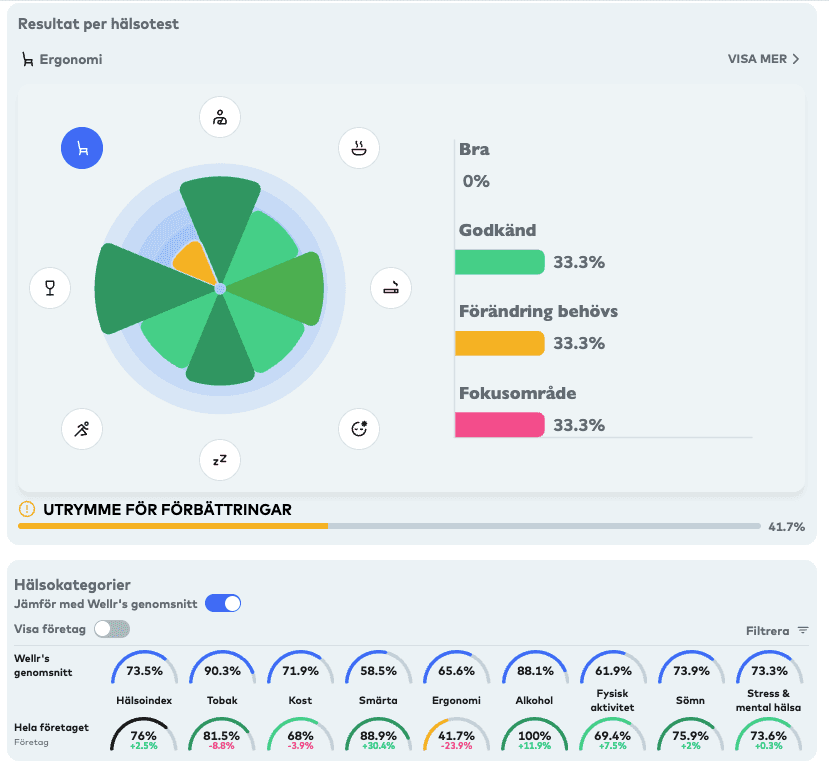
It was in that gap that Wellr’s health module emerged. In the app, eight key health areas are brought together in a single Health Index – an average value that provides an overview of the current situation, both for the individual and for the organisation. It covers stress and mental health, pain, physical activity, diet, sleep, alcohol, tobacco and ergonomics. Together they provide a broad and nuanced picture of how employees experience their situation right now.
But behind the index lies a bigger ambition.
“We saw that many organisations wanted to work more preventively, but lacked the structure to do so over time. Health is complex. If we don’t measure it in a thoughtful way, it easily becomes something we talk about but don’t follow up on,” says Anders Hamberg, one of the founders of Wellr.
A thermometer without right or wrong The health module is not intended as a test where someone passes or fails. It works more like a thermometer. The individual’s results show a current state and can be linked to concrete health plans in the app. At organisational level, a consolidated picture is created at the same time of where strengths and areas for improvement lie.
A crucial principle is anonymity. Each employee’s profile is completely anonymous and the employer only has access to aggregated statistics at group level.
“Anonymity is key. When people feel safe, they dare to answer honestly. And only then do we get data that we can actually work with,” says Anders.
This makes it possible to shift the focus from individuals to patterns. Instead of asking who is unwell, the question becomes what needs to be adjusted in the organisation.
When direction matters more than the number The strength of the tool lies not only in the snapshot, but in the ability to track developments over time. When data from 2025 is compared with 2024, patterns emerge. How has the average Health Index changed? Have stress levels increased or decreased? How are physical activity and sleep developing?
Here, Wellr can extract exact figures from the system, for example how many percentage points an area has improved or deteriorated, or what proportion of organisations have physical activity as their main area for improvement.
“The most interesting thing is not a single number, but the direction. When we see how an area moves over time, organisations get a completely different basis for decisions. Health then becomes a strategic issue, not just a matter of well-being,” says Anders.
It is in the movement over time that the value arises. One measurement can provide insight. Several measurements provide a basis for change.
From one-off initiatives to continuity Over the years, many organisations have tried campaigns, theme weeks and inspirational talks. The effect can be positive, but it is often temporary. Without follow-up, it is difficult to know whether anything has actually changed.
Wellr’s health module is built for continuity. Employees can repeat the tests and track their own development. At the same time, the organisation can see how the group level changes and whether initiatives are having an effect. This creates a cycle where insight leads to action, which in turn can be followed up and adjusted.
For example, it may turn out that ergonomics is a recurring area for improvement in a certain part of the organisation. Or that stress levels rise during particular periods. With clear data, measures become more accurate and resources can be directed where they do the most good.
Health as part of the business At a time when mental ill-health and stress-related sick leave are among the main causes of long-term absence from working life, the ability to work systematically with health is becoming increasingly crucial. The health module in Wellr is not a replacement for work environment efforts, but it serves as a complement – a tool that makes patterns visible before they turn into costly problems.
When the individual perspective is combined with anonymised group statistics, a bridge is created between the personal and the organisational. That is where the real strength lies.
Health does not become a campaign. It becomes part of the structure.