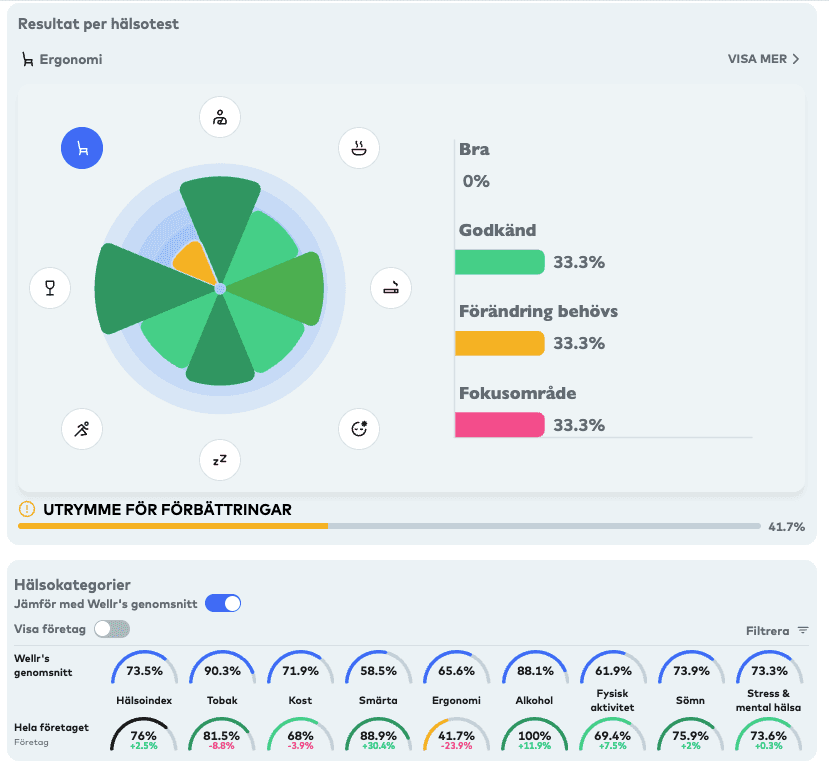

With Wellr, you can easily and enjoyably map and improve your health. You start by doing your digital health check, which takes between 10 and 20 minutes to complete. When you are done, your individual health profile is created and you find out how you are doing in each health area. The Wellr system then tailors actions based on your needs, your level of ambition, and your motivation. With Wellr, you get the right tools to optimize your health.
Here are some tips on how to succeed with your health efforts and avoid pitfalls.
1. Set goals Most people have at some point followed a recipe when cooking. That’s a good analogy when it comes to setting and reaching a future goal. The goal is the finished dish and the recipe is the strategy, that is, how you manage to achieve the goal. Setting goals helps you make concrete what it is you want to achieve. If you know exactly what you want, you also know where to focus your efforts. Setting goals gives you a long-term vision and, in the short term, motivation. A good goal-setting model is “SMART” goals.
SMART goals
Specific. The first cornerstone of the SMART goal concept is that goals must be specific. A goal is specific when it is very precise and well defined, and cannot be misinterpreted in any way.
Measurable. Goals should be measurable. This means it should be easy to know when you have met the goal in terms of time, quantity, and quality.
Accepted. You should feel that you actually want to do what you are going to do. It is important that you can stand behind your goals and thus accept what they entail.
Realistic. It is very important that the goal is reasonable and realistic. But at the same time, it should be challenging.
Time-bound. When you set goals, it is important that you have clear start and end dates. Above all, it is important to set a specific point in time when the goal should be achieved. If you set a long-term goal, it is effective to break it down into smaller sub-goals. This means you succeed more often, which strengthens your self-confidence and helps maintain your motivation. Having a plan is a good start, but it does not mean the goal will be reached – you have to turn it into action. It’s about making a decision and every day doing something, small or big, that takes you closer to your goals. Every day you can do something in the right direction if you prioritize your time!
2. Find your “why” Goal-setting is a so-called “what” thing, but to achieve it you need a “how” thing, that is, a strategy. And if we think about “why” we want (or need) to succeed with our goal, we have a purpose that gives us lasting motivation. At the end of the day, your “why” is your vision. A vision is something that has not happened yet. It is the future. It is the image that pulls you forward. And it can be driven by something inspiring, or initially by something that is perceived as negative. Ask yourself: Why do I want to make a change? What positive aspects will it bring me and my loved ones? And what will the negative aspects be if I don’t? Write down what you come up with. You can go back and look at these lines when you feel your motivation starting to fade.
3. Create new routines It is important that new routines become lasting. That’s why you want to turn your new behaviors into habits. The trick is to make it easy to get started. In fact, it should be extremely easy, so easy that it’s almost impossible to fail. Keep the threshold low! It can be very helpful to schedule your health activities in your calendar. That increases the likelihood that they will actually happen. Avoid thinking that you are not good enough – there is no reason to worry about your results before you have even started.
4. Avoid procrastination Procrastination is when you put things off even though you know it will have negative consequences in the long run. When you have a goal, such as starting to exercise or losing weight, it is a plan for your future self. You visualize how you want your life to look in the future. When you think about the future, it is easy for the brain to see the value in taking actions with long-term benefits. But when it is time to make a decision, it is no longer about choosing for your future self. All of a sudden, you are in the present. And in the present, you have to start acting to get what you know you will want in the future. Researchers have found that your present self prefers an immediate reward rather than a long-term one. It is therefore important that you train yourself to say no to immediate rewards – something you should be consistent with in order to bridge the gap between where you are and where you want to be. Succeeding in reaching your goals requires you to ignore doing what is easy (hitting the snooze button) and instead choose to do something harder (getting up right away in the morning).
Good luck with your health journey!